Organization Profile & Registration Certificate
PART 1: BACKGROUND
Bangladesh is a developing country in south-east Asia with a
population of over 148 million. Over 47 million of these
people are living below the poverty line, the most vulnerable
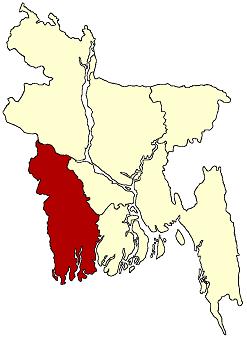
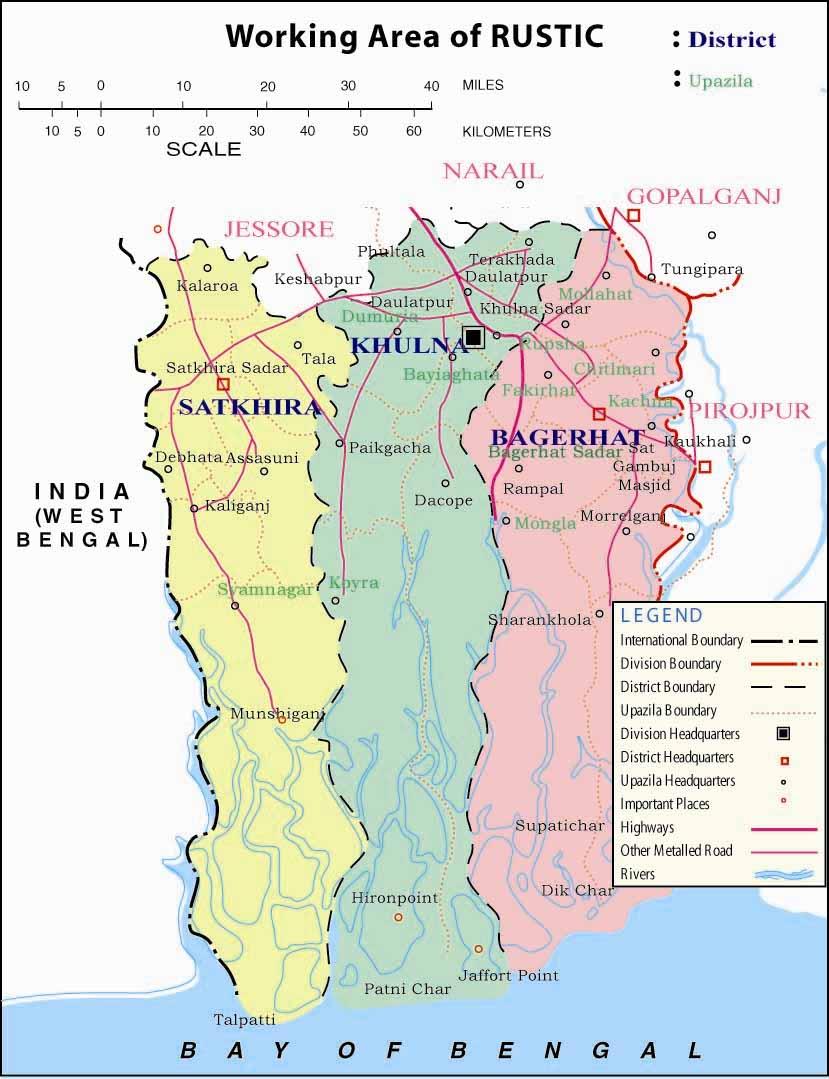
of which being the women and children. The Khulna region,
including Bagerhat, is located in the remote south-western
part of the country. The disaster prone coastal area has
endured at least five major or large scale natural disasters
within last 15 years, including Sidr, Iila, Amphan and
Reshmi- all taking place in the last decade. It also stands at
a distance from the major economic center of Dhaka. The
infrastructure is poor and communication can at times be
treacherous. As a result, the region is vulnerable to socio-
economic
challenges.
Disasters,
both
natural
(the
environment) and man-made (the economy) are the root causes of the issue. Lack of education
and absence of comprehensive data means that these problems are compounded in terms of
deciding the ground reality and set correct course of action.
Despite enormous possibilities (Khulna is the second largest sea-port in the country), rampant
and non-stop de-industrialization adds fuel to the worst case scenario. At least 230 large and
small industries shut down or called lay-offs in the region in last two decades. COVID-19 has
worsened an already fragile situation to say the least. This dealt a heavy blow to an already
under-employed population, especially for the urban or pro-urban populations.
Attempts to increase the agricultural yield and protect human settlements from cyclone and tidal
surge embankments led to the construction of the Coastal Embankment Project (CEP). Yet
since the 1960s, this government intervention has had an adverse impact on one of the most
complex and biologically productive ecosystems in the world; almost permanent drainage
congestion and water logging have endangered traditional agriculture and livelihood in the
region. Moreover, much of the agrarian land is becoming permanently or partially barren
because of saline water due to indiscrete cultivation of so-called shrimp and shrimp-fish
polycultures.
Since
1988,
social
activists
began
raising
awareness, giving suggestions and providing
financial, technical and mental support in order to
find a possible solution to the population’s
problems. They intended to establish a formal, legal
and workable organization to ensure safe water
and sanitation, conserve bio-diversity, enhance
human rights, and eradicate illiteracy, superstition,
and the hypocrisy of religious fundamentalism from
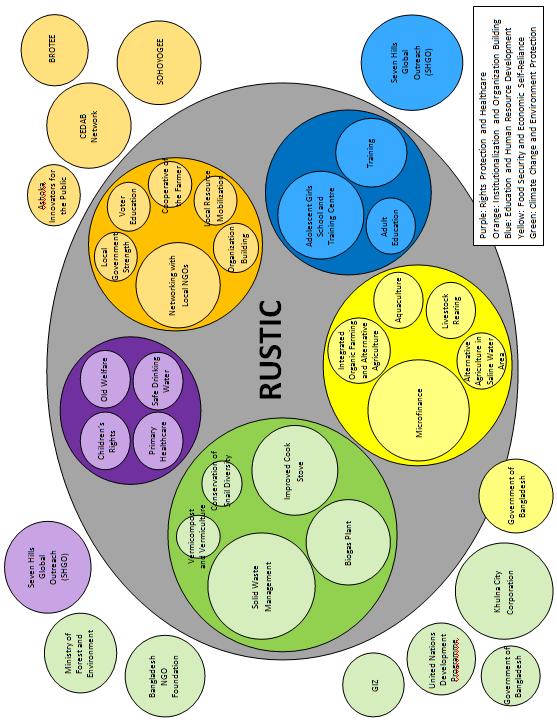
the society. Therefore, RUSTIC emerged as a
voluntary social development organization for the
helpless to establish themselves financially, socially
and culturally. RUSTIC targets the poorest of the
community irrespective of race, cast or creed for an
integrated development.